

Friday, August 28, 2026 – 11.30am | 10 min read
Heart failure is a clinical syndrome with many underlying causes. The symptoms may overlap, but the biological mechanisms driving them can be very different.
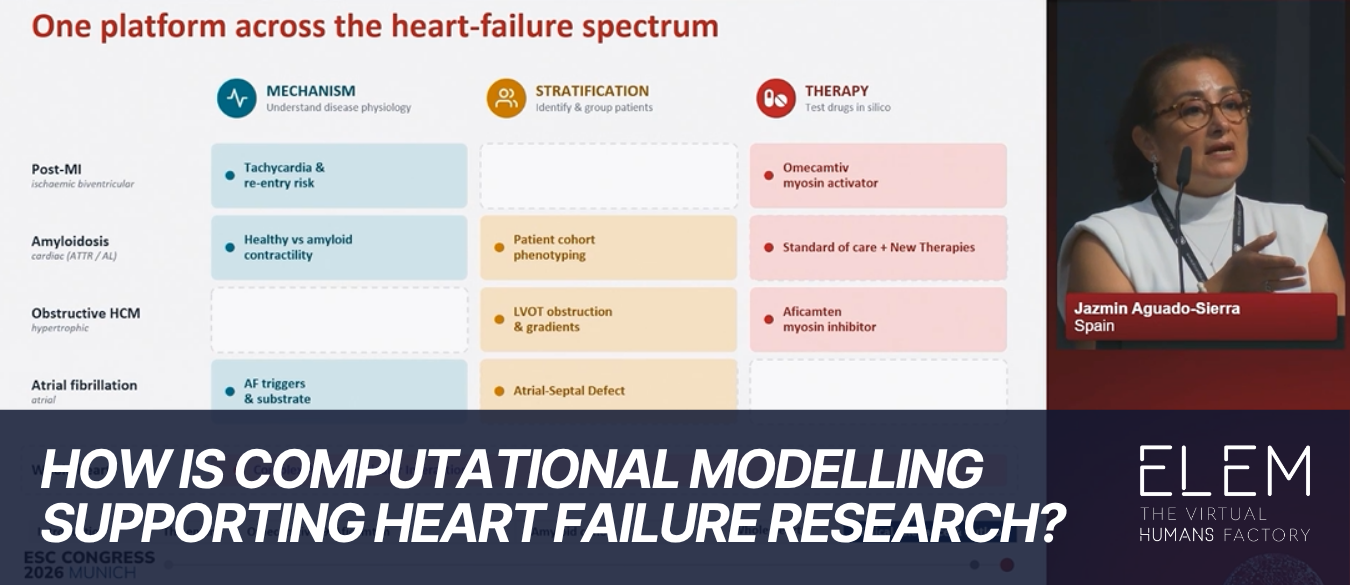
In ischaemic cardiomyopathy, myocardial injury and remodelling after infarction alter ventricular function. In obstructive hypertrophic cardiomyopathy (HCM), changes in myocardial contractility and myosin function contribute to hypercontractility and left ventricular outflow tract obstruction. In ATTR cardiac amyloidosis, amyloid deposition progressively increases extracellular volume and myocardial stiffness.
At ESC Congress 2026 in Munich, Jazmin Aguado-Sierra presents research exploring whether these distinct forms of heart failure can be represented within a common mechanistic, electromechanical modelling framework.
Jazmin is a Visiting Researcher at the Barcelona Supercomputing Center (BSC) and Lead Scientist at ELEM Biotech. The work presented at ESC Congress has been developed through collaboration between BSC and ELEM.
Same syndrome, different mechanisms
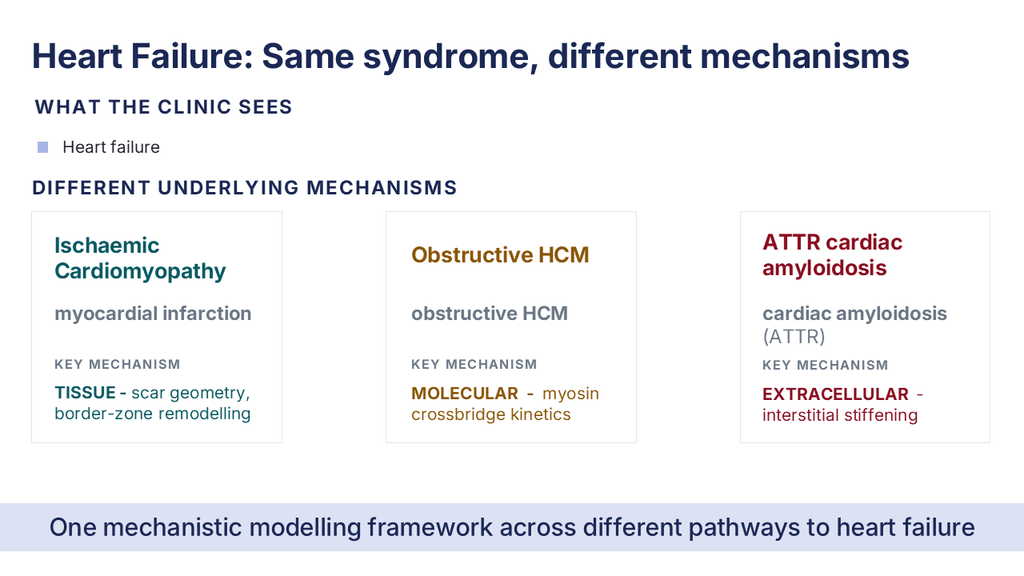
A central challenge in heart failure research is connecting what clinicians observe at the organ level with the biological processes driving disease at cellular and tissue scales.
The modelling work presented at ESC applies a common biophysical framework across ischaemic cardiomyopathy, obstructive HCM and ATTR cardiac amyloidosis, linking cellular- and tissue-level behaviour with whole-heart electrophysiology, mechanics and haemodynamics.
Rather than treating heart failure as homogeneous, the models aim to capture how different disease mechanisms produce different functional consequences in individual patients.
From clinical data to a virtual heart
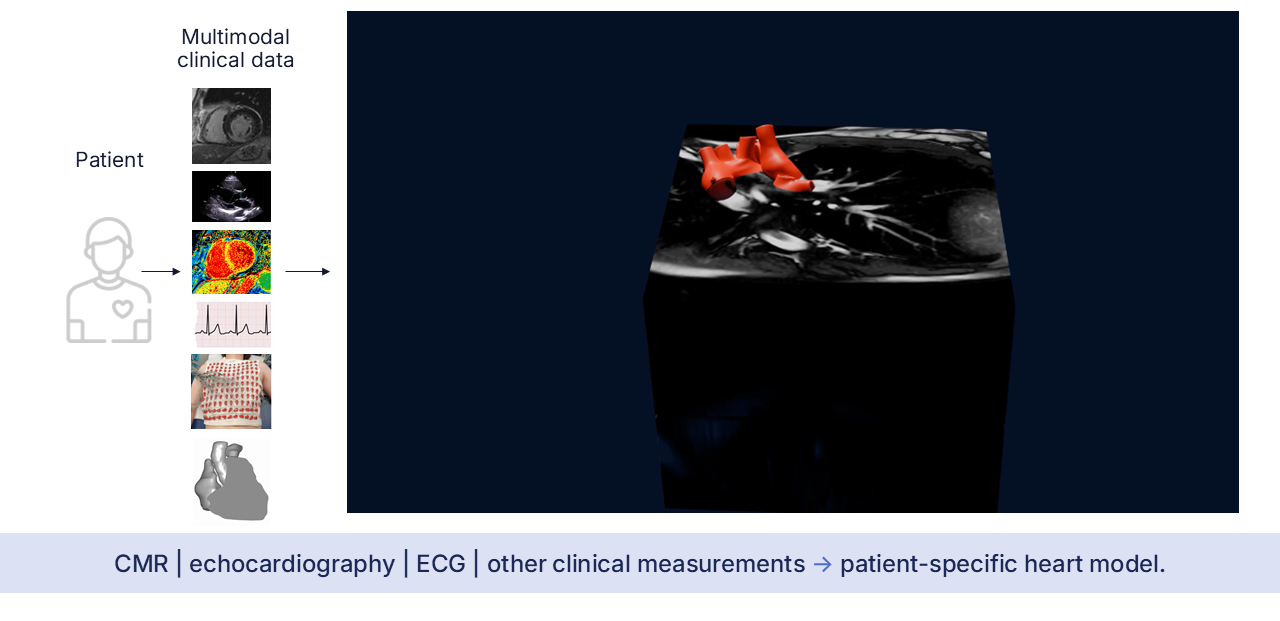
The modelling process starts with patient data.
Information from cardiac magnetic resonance, echocardiography and electrocardiography can be combined with physics-based
models of electrophysiology, contraction, haemodynamics and circulation to create a patient-specific computational representation of the heart.
These virtual hearts are designed to reproduce measurable aspects of cardiac physiology while also allowing researchers to investigate variables and mechanisms that may be difficult to assess directly in an individual patient.
Researchers can then change model parameters to explore how differences in contractility, tissue properties or haemodynamics affect cardiac performance, and to investigate questions related to therapeutic response, patient stratification and clinical endpoints.
From individual virtual patients to virtual cohorts
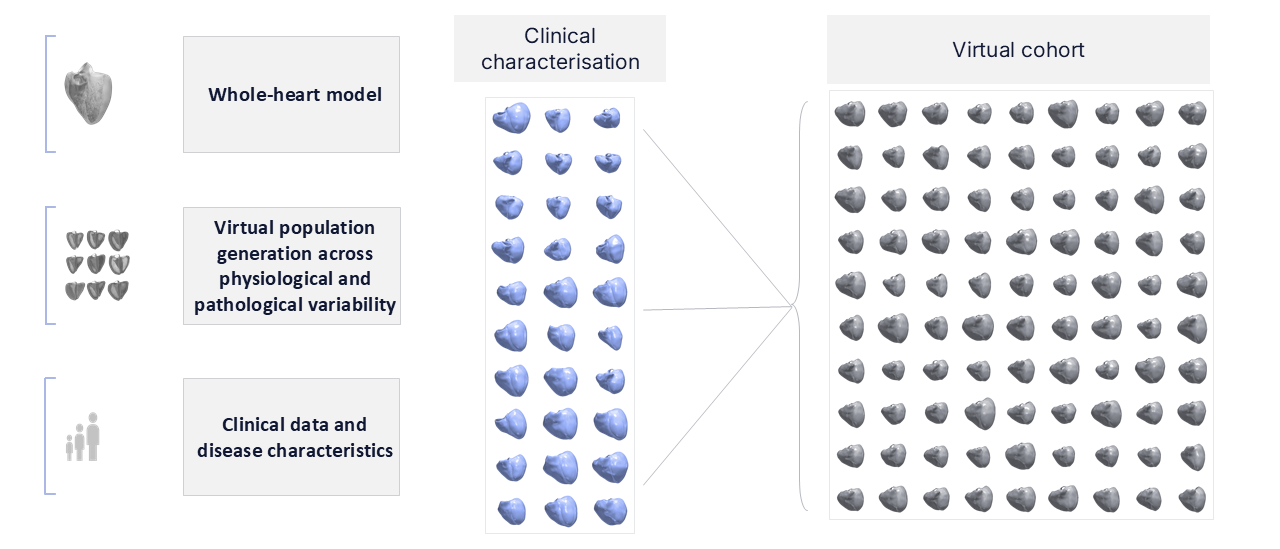
Patient-specific models can also be extended into virtual cohorts: computational populations designed to represent physiological and pathological variability.
One example presented at ESC focuses on ATTR cardiac amyloidosis. Clinical data from patients with ATTR-CM were used to construct virtual representations that incorporate electrophysiological, structural, systolic, and diastolic characteristics.
When the clinical and virtual cohorts were compared, no statistically significant differences were observed for QRS duration, QTc, left ventricular ejection fraction, or E/A ratio.
This does not mean that a virtual cohort is equivalent to a clinical population in every respect. It is instead a step towards establishing whether selected clinically relevant characteristics can be reproduced within the modelling framework.
For computational models to contribute meaningfully to cardiovascular research, validation must be specific to the model’s intended use, the variables being studied, and the scientific question being asked.
Exploring therapeutic response in silico
The ESC presentation also includes examples of patient-specific modelling used to investigate therapeutic responses.
In obstructive HCM, modelling examines changes in haemodynamic parameters and myocardial work before and after therapy. In ischaemic cardiomyopathy, it explores how changes in myocardial contractility influence ventricular function and mechanical performance.
These simulations provide a way to investigate why different patients may respond differently to the same therapeutic intervention.
In clinical development, such approaches may help researchers explore treatment scenarios, characterise responder profiles, and refine questions for subsequent clinical evaluation.
How could virtual cohorts contribute to clinical development?
Beyond modelling disease mechanisms, virtual patients and cohorts could provide an additional environment for investigating questions before or alongside conventional clinical studies.
Potential applications include:
- investigating mechanisms underlying disease and treatment response;
- exploring therapeutic scenarios;
- identifying and characterising patient subgroups;
- supporting patient stratification;
- evaluating potential clinical endpoints; and
- generating hypotheses for clinical studies.
Virtual cohorts may also help researchers explore variability in populations that can be difficult to represent adequately in conventional studies, including rare-disease populations and groups historically underrepresented in clinical research.
Their usefulness, however, depends on the quality and representativeness of the underlying clinical data, the biological assumptions encoded in the model, the strength of its validation, and the question it is intended to answer.
The opportunity is to combine mechanistic simulation with clinical evidence, rather than replace one with the other.
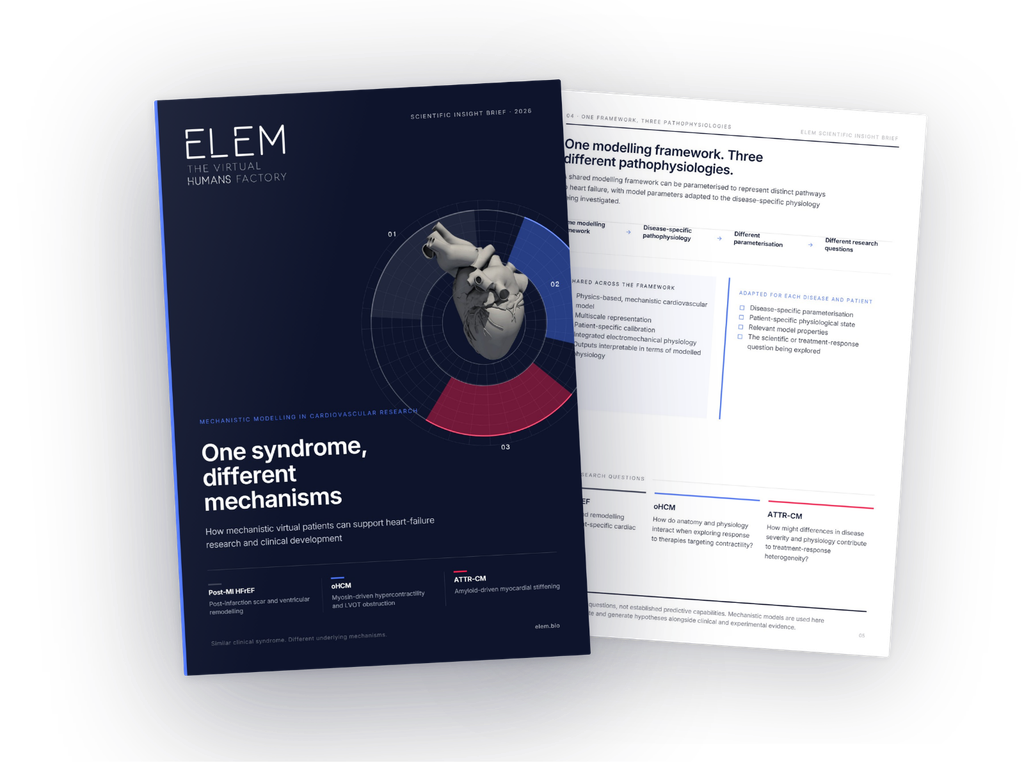
Exploring heterogeneous treatment response in cardiovascular development?
In this document we explained how patient-specific mechanistic modelling can support heart-failure research and clinical development:
A mechanistic complement to AI
Artificial intelligence is a major theme of ESC Congress 2026, and physics-based modelling offers a complementary approach.
Data-driven AI systems typically identify patterns and relationships within datasets. Mechanistic models instead encode knowledge about how biological and physical systems behave and use those relationships to simulate outcomes.
This can generate physiologically interpretable information linking tissue properties, electrophysiology, myocardial mechanics, and haemodynamics.
Mechanistic and data-driven approaches can also inform one another. Virtual patients and virtual cohorts may provide structured physiological information that can be combined with statistical and AI-based methods as computational approaches move closer to clinical research and drug-development decision-making.
Jazmin at ESC Congress 2026
Jazmin Aguado-Sierra participated in ESC Congress 2026 with:
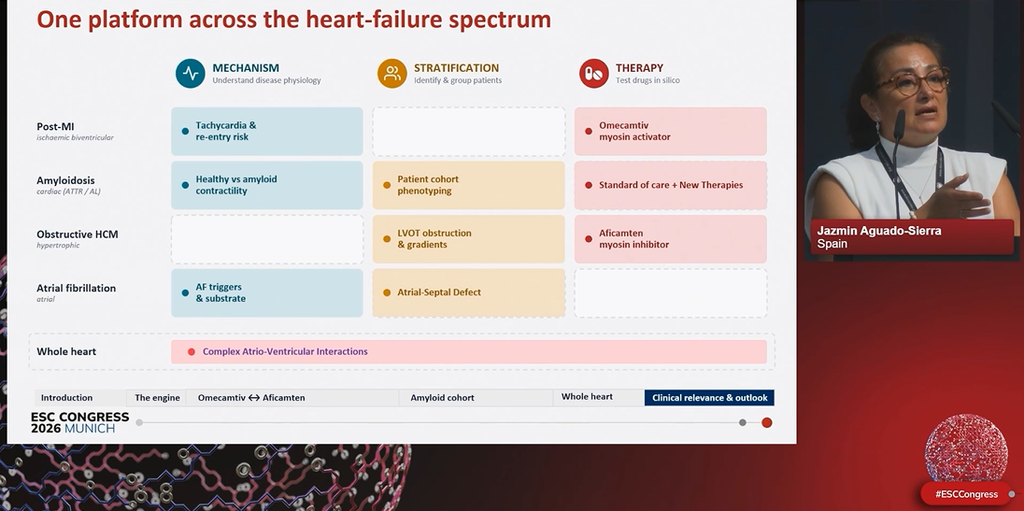
1- Research presentation: Electromechanical computational modelling of heart failure
Date: Friday, 28 August | 11:00 – 11:12
Where: Tashkent (Hall A3)
2 – Chai in a moderated ePoster session: Artificial intelligence tools in clinical trials and precision medicine
Date: Saturday, 29 August | 16:15 – 17:00
Where: Station 4 (Research Gateway Hall A1)
Jazmín is listed in the ESC Congress programme under Barcelona Supercomputing Center affiliation. She is also Lead Scientist at ELEM Biotech, and the research presented reflects the scientific collaboration between BSC and ELEM.
Together, the sessions provided an opportunity to discuss both the scientific foundations of patient-specific cardiac modelling and the wider role computational approaches could play in cardiovascular research and clinical development.
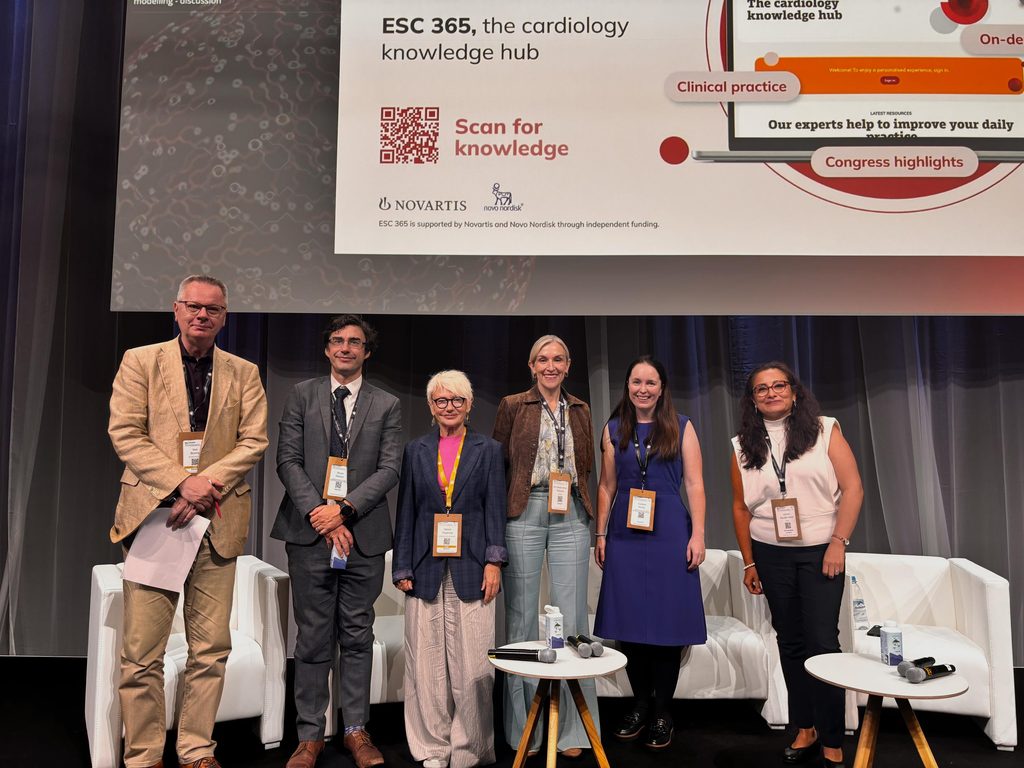
Jazmín Aguado-Sierra Interview by Touch Cardio after her Computational Modelling session:
🔗 How can computational modelling help personalize heart failure treatment?
Exploring computational modelling in cardiovascular development
At ELEM Biotech, we develop mechanistic computational approaches that connect cardiac physiology, patient data and therapeutic questions.
For teams investigating heterogeneous treatment response, patient stratification or the potential role of virtual cohorts in a cardiovascular development programme, ESC Congress 2026 is an opportunity to discuss where patient-specific modelling could provide useful evidence.
Curious to find out more about computational model applications after ESC?
We are here to answer your questions and show you how our virtual hearts and virtual cohorts can support your programme.
Want to see the benefits of a virtual heart platform? Check it here: