

Why uncertainty is becoming a critical test for AI in cardiac safety assessment
A peer-reviewed loperamide study has examined how variability in experimental ion-channel measurements affects QT predictions generated by sex-specific cardiac digital twins. The results show that relying on one set of mean experimental inputs can conceal a broader range of model-predicted outcomes, particularly near transitions to unstable electrical behaviour.
Discussions about AI in drug development often focus on speed and efficiency. In safety assessment, however, rapid results are only valuable if we understand the reliability of the outcomes and the model’s potential limitations.
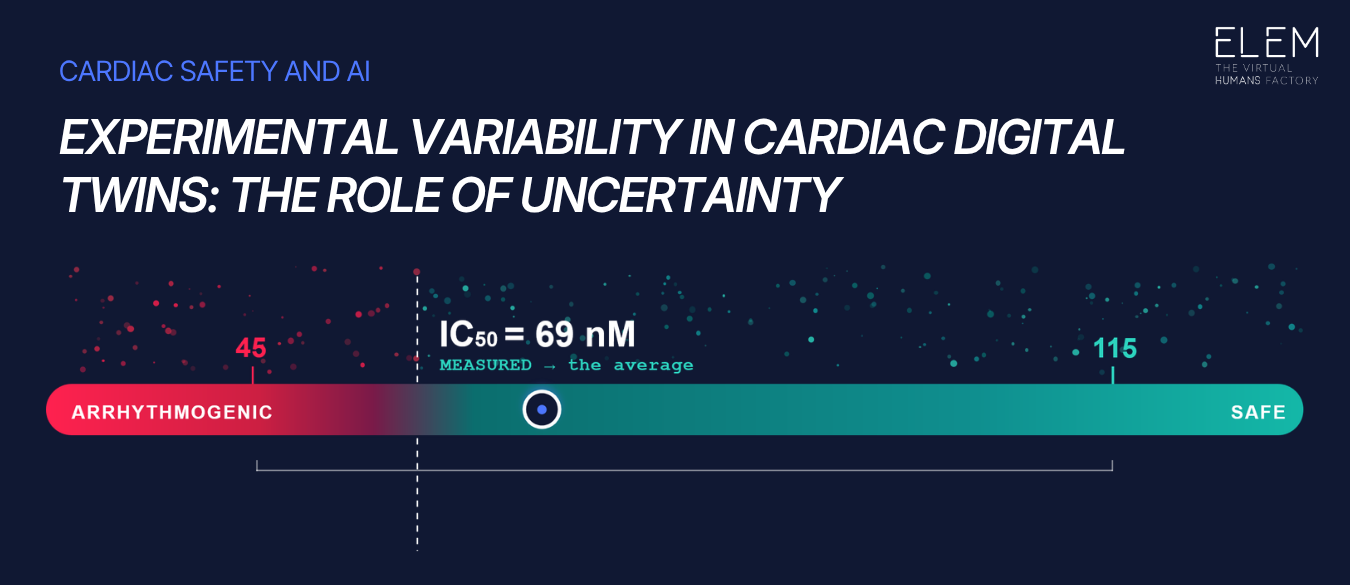
Cardiac safety assessment relies on experimental data, such as measurements of a compound’s effects on cardiac ion channels. These values, including IC50 and Hill coefficients, can vary across experiments, assay conditions, and laboratories. Using only average values in computational models may mask the underlying uncertainty in the data.
A recent study in Regulatory Toxicology and Pharmacology adopted a different approach by retaining experimental variability within the model. Using loperamide as a test case and incorporating sex-specific differences, the researchers efficiently simulated numerous scenarios that would otherwise require significant time to replicate or have ethical constraints, by assessing large, supratherapeutic doses.
Why loperamide?
Loperamide is a widely used medication that is safe at recommended doses. However, at significantly higher doses, it can cause serious cardiac arrhythmias. This makes it a valuable case for examining how variability in laboratory tests affects cardiac predictions and how computational models perform under extreme conditions.
The study sampled observed variability in ion-channel parameters and applied it to male and female cardiac emulators. It assessed predicted QT prolongation and arrhythmic outcomes across a range of exposures, from therapeutic to extreme concentrations. Researchers also validated selected conditions against the full 3D simulator, focusing on scenarios near arrhythmic transition boundaries where surrogate models are most challenged.
What the study found
At therapeutic exposure, the simulations produced negligible changes in QT and no arrhythmic events. At supratherapeutic concentrations, propagating the observed variability in ion-channel IC50 and Hill coefficient measurements produced a broader spread of predicted QT responses, particularly near the transition to arrhythmic behaviour. The findings show how incorporating variability in experimental inputs can reveal a range of model-predicted outcomes that would not be visible from a single set of mean input values.
The study found lower model-derived arrhythmogenic thresholds in female virtual hearts compared to male virtual hearts. Under plasma-adjusted conditions, arrhythmic events first appeared at about 107–109 times the reference Cmax in female models and 213–286 times Cmax in male models. These results reflect virtual scenarios and are not clinical dosing thresholds, patient predictions, or guidance for interpreting individual overdoses.
“Experimental ion-channel data are essential to cardiac safety assessment, but these measurements can vary across experiments and conditions. Carrying that variability through the simulations helps reveal a range of possible model outcomes rather than relying on a single point estimate, illustrating how computational approaches can complement established safety-pharmacology methods.”
—Georg Rast, co-author of the study and Director General Pharmacology, Boehringer Ingelheim Pharma GmbH & Co. KG and co-author of the study
Why uncertainty matters
Acknowledging uncertainty does not resolve the issue, but it clarifies areas of weakness. For researchers, this approach identifies key factors influencing results, highlights gaps in knowledge, and guides further investigation.
This approach uses AI tools to address meaningful biological questions. These emulators, trained in detailed heart simulations, allow researchers to explore multiple scenarios efficiently. The goal is not to replace human insight, but to provide a broader perspective.
What this study does not show
This work does not suggest that computational models replace laboratory assays, animal studies, clinical trials, or clinical judgment. It does not predict individual patient outcomes and should not be interpreted as directly predicting torsades de pointes in clinical practice. The authors note that surrogate-model accuracy may decrease near arrhythmic transitions and under extreme ion-channel blockades that are underrepresented in training data, which is why targeted validation against the full simulator was performed.
Clinical reports of loperamide cardiotoxicity arise under varied circumstances and sometimes at lower concentrations than the model-derived arrhythmic thresholds. Patient conditions, co-administered substances, electrolyte imbalances, toxicokinetics, and transient physiological factors all influence real-world outcomes. The model’s arrhythmia classification is deterministic, whereas for clinical events the multitude of influences is not entirely accessible; therefore, statistical considerations of populations are required.
A more useful question for scientific AI
The next generation of AI in drug development must go beyond rapid predictions. Models should provide supporting evidence, clearly communicate uncertainty, and define the limits of their confidence.
This loperamide case study illustrates a shift in cardiac safety assessment from seeking a single answer to exploring a range of possible outcomes, the factors influencing them, and the limitations of current models.
What this means for cardiac safety assessment
“All experimental measurements have an error, and this uncertainty can influence what a computational model predicts. In this study, we carried that uncertainty through the simulations rather than reducing it to a single average value. This allowed us to see where predicted QT responses remained consistent and where outcomes became more sensitive, particularly close to transitions in electrical stability.”
—Jazmin Aguado-Sierra, Scientific Lead at ELEM Biotech and co-author of the study.
Paper
Paula Dominguez-Gomez et al., “AI-enhanced cardiac digital twins extend drug proarrhythmic risk assessment through experimental data uncertainty propagation and overdose exploration: A loperamide case study”, Regulatory Toxicology and Pharmacology 171 (2026) 106138. Available online 1 June 2026. DOI: 10.1016/j.yrtph.2026.106138.
Where can you trust your model’s prediction — and where does uncertainty matter?
Every experimental input carries variability. See how it can influence cardiac safety predictions — and discuss what this could mean for your compound.
Ready to explore the full space of IC50 and H combinations?
Use V.HEART Discovery to explore how different ion-channel inputs can influence predicted cardiac responses.